
Product roadmaps don’t write themselves. Every SaaS company faces the same challenge: too many ideas, limited resources, and the pressure to ship features that actually matter. The key to success lies in how SaaS teams decide what to build next, making the right product decisions can mean the difference between growth and stagnation.
So how do successful teams cut through the noise? They use a mix of data, customer feedback, and strategic thinking. But the process isn’t as simple as picking the loudest request or the shiniest new feature. Let’s break down how high-performing SaaS teams actually make these critical decisions.
Starting with the Customer (But Not Stopping There)
Customer feedback feels like the obvious place to start. After all, who knows what the product needs better than the people using it every day?
Here’s the thing: customers are great at identifying problems. They’re less reliable at prescribing solutions. A support ticket saying “I need better reporting” might actually mean “I can’t prove ROI to my boss” or “The data I need is buried across three different screens.”
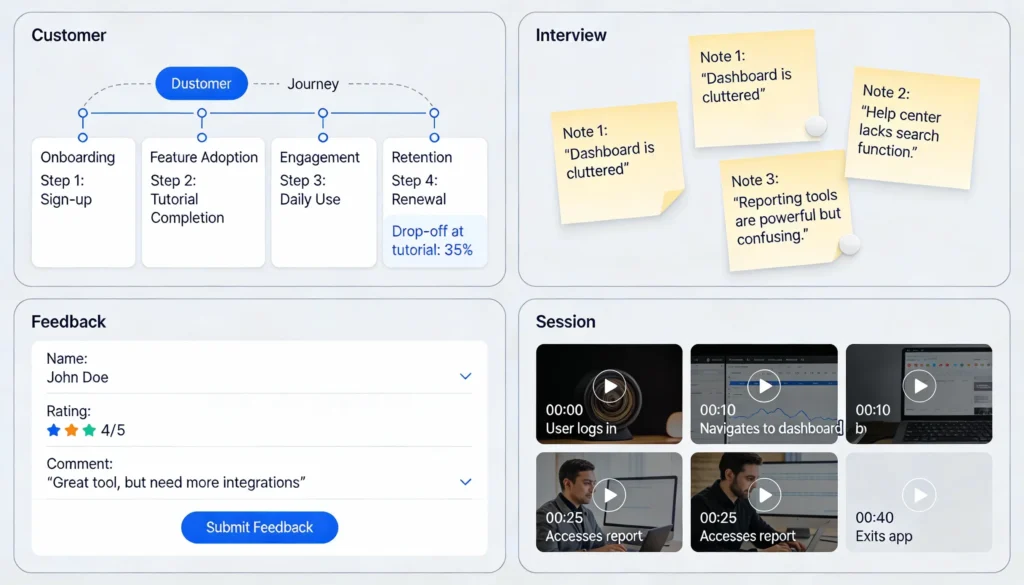
Smart teams dig deeper. They conduct user interviews, watch session recordings, and analyze support conversations looking for patterns. One feature request from a whale customer might carry more weight than fifty requests from free trial users. Context matters.
But customer input alone creates blind spots. Users can only ask for improvements to what they already see. Henry Ford’s famous line applies here: if he’d asked customers what they wanted, they would have said faster horses. Sometimes the best SaaS product decisions come from anticipating needs customers don’t yet recognize.
The Data Tells a Story (If You Know How to Read It)
Usage analytics reveal what customers do, not just what they say. Low adoption of an existing feature might signal poor discoverability, confusing UX, or simply that you built something nobody wanted.
Product teams track metrics like feature adoption rates, time to value, user retention by cohort, and where people drop off in key workflows. These numbers point toward opportunities.
Say your analytics show that 60% of new users abandon the product during onboarding. Building a fancy AI feature probably isn’t your priority. Fixing that leak in the bucket comes first.
The best teams create weighted scoring systems. They might assign points based on potential impact, number of affected users, strategic alignment, and development effort. This quantifies what would otherwise be subjective debates.
But data can mislead too. A rarely used feature might be crucial for enterprise deals even if only 5% of users touch it. A highly requested feature might satisfy vocal users but fail to move revenue. Numbers need interpretation.
Aligning with Business Goals (The Boring Part That Actually Matters)
Every feature request should answer a simple question: how does this move us toward our business objectives?
Maybe you’re focused on reducing churn. That makes improving the core workflow more valuable than adding peripheral features. If expansion revenue is the goal, building functionality that encourages upgrades takes priority.
Some SaaS companies map features to specific outcomes:
- Activation features: help new users reach their “aha moment” faster
- Retention features: give existing users more reasons to stay
- Expansion features: create natural upsell opportunities
- Acquisition features: make the product more discoverable or shareable
This framework prevents teams from building features that feel productive but don’t serve strategic needs. It’s surprisingly easy to stay busy while accomplishing nothing meaningful.
Market positioning matters too. If you’re competing on simplicity, adding complexity might win individual deals but erode your core advantage. If you’re the “enterprise-grade” option, consumer friendly features might dilute your brand.

Balancing Quick Wins Against Big Bets
Product roadmaps need both sprints and marathons. Quick wins build momentum, prove the team can ship, and deliver immediate value. Big bets create competitive moats and step function improvements.
The trap is focusing only on low hanging fruit. That path leads to a bloated product with dozens of half baked features. None of them deliver transformative value.
Conversely, spending six months on a moonshot feature means six months without shipping anything users can touch. Momentum stalls. Team morale suffers. Competitors gain ground.
Many SaaS teams adopt a portfolio approach. Maybe 70% of capacity goes to core improvements and clear user needs. Another 20% funds bigger initiatives that might take a quarter to ship. The final 10% goes to experimental features or technical debt.
The exact split varies, but the principle holds: balance immediate value against long-term differentiation.
The Role of Competitive Intelligence
Your competitors influence SaaS product decisions whether you acknowledge it or not. Customers compare your product to alternatives. Sales teams face objections about missing features.
Some teams maintain competitive matrices tracking what rivals offer. Others subscribe to competitor products to understand their strengths. The goal isn’t copying features. It’s understanding the landscape.
When a competitor ships something new, smart teams ask: Is this table stakes now? Is it a genuine innovation or window dressing? Does it matter to our specific customer segment?
Sometimes you need feature parity just to stay in consideration. If every other project management tool offers Gantt charts, you might need them too—not because they’re revolutionary, but because buyers expect them.
Other times, a competitor’s feature becomes an opportunity to differentiate. They went complex; you stay simple. They focus on enterprises; you double down on mid-market teams.
Technical Feasibility and Resource Constraints
The best product idea means nothing if you can’t build it—or if building it would consume your entire engineering team for six months.
Technical debt enters the equation here. That clunky legacy code might make even simple features take twice as long. Refactoring isn’t sexy, but sometimes it’s necessary before you can move forward.
Team capacity and expertise matter. A feature requiring specialized skills your team lacks might need external contractors or new hires. That changes the timeline and cost calculation.
Some teams use a “cost of delay” framework. They estimate both the value of shipping a feature and the cost of waiting. High value and high cost of delay? That feature jumps the queue. Low value but also low cost of delay? Defer it indefinitely.
Infrastructure considerations factor in too. Will this feature scale? Does it create new security vulnerabilities? Will it complicate compliance? These questions prevent you from building features that create bigger problems down the road.

When to Say No (And How)
Deciding what not to build is harder than deciding what to build. Every declined feature request disappoints someone.
The key is explaining the reasoning. “We’ve decided to focus on X instead” feels better than “Your idea didn’t make the cut.” Transparency about priorities and constraints builds trust.
Some teams maintain a public roadmap showing what’s in progress and what’s being considered. Others keep roadmaps internal to maintain flexibility. Both approaches work if you’re consistent about communication.
The phrase “not now” is more useful than “no.” Maybe a feature doesn’t fit current priorities but could make sense next quarter. Parking ideas in an “under consideration” category acknowledges their value without committing resources.
Strategic nos are powerful. Apple famously says no to far more features than it ships. That discipline creates focus and prevents product bloat. Your SaaS probably isn’t Apple, but the principle applies at every scale.
Bringing It All Together
SaaS product decisions work best as a structured process, not gut feeling or internal politics. The strongest teams combine multiple inputs: customer feedback, usage data, business objectives, competitive landscape, and technical reality.
They avoid common traps. Defaulting to the loudest voice in the room. Building features only for the biggest customer. Chasing competitors without understanding why. Ignoring technical debt until it becomes a crisis.
Instead, they create frameworks that make decision-making more consistent and defensible. They communicate priorities clearly. They revisit decisions regularly as conditions change.
Most importantly, they accept that perfect information doesn’t exist. You’ll make some wrong calls. That’s fine as long as you’re learning and adjusting. The goal isn’t getting every decision right. It’s having a process that consistently points you in the right direction.

A SaaS analyst covering product strategy, growth, and customer experience in modern software businesses. Focused on practical insights and real-world SaaS execution.