Your sales team just closed 40 new customers this month. Everyone’s celebrating. But nobody’s asked the one question that actually matters: did those 40 customers cost you more to acquire than they’ll ever pay you back?
That’s what the LTV to CAC ratio tells you. It’s the one number that separates a SaaS business that’s quietly bleeding cash from one that’s actually built to scale. And yet most founders either don’t calculate it, or calculate it wrong.
This guide breaks down the ltv to cac ratio saas formula, walks through a real example with numbers, and shows you what counts as a good ratio – and what to do if yours isn’t there yet.
What Is LTV to CAC Ratio in SaaS?
LTV to CAC ratio compares how much revenue a customer generates over their lifetime (LTV — Lifetime Value) against how much it cost to acquire them (CAC — Customer Acquisition Cost).
Put simply: for every dollar you spend getting a customer, how many dollars do you get back?
Some people write it as LTV:CAC, others as CAC:LTV — but “ltv cac or cac ltv,” they mean the same comparison. The convention that’s stuck in SaaS is LTV:CAC, expressed as a ratio like 3:1.
LTV to CAC Ratio Formula
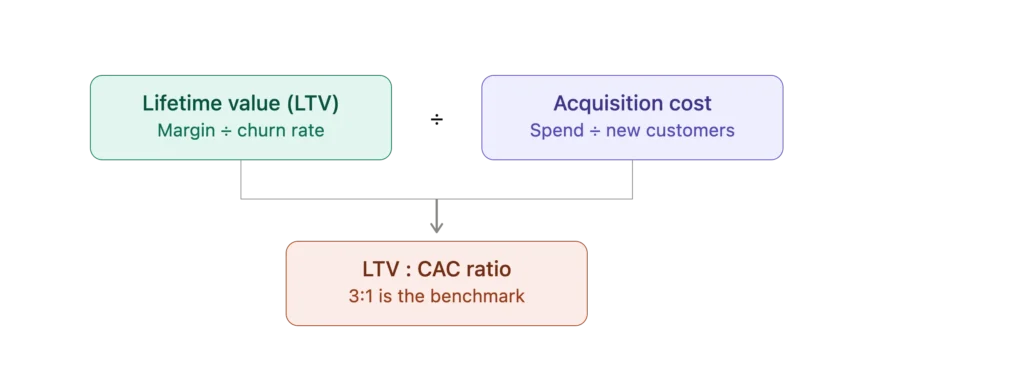
Here’s the ltv to cac ratio saas formula:
LTV : CAC Ratio = Customer Lifetime Value ÷ Customer Acquisition Cost
To use this, you first need both numbers individually.
LTV Formula (SaaS)
LTV = (Average Revenue Per Account × Gross Margin %) ÷ Churn Rate
Or, in its simpler form often used by early-stage teams:
LTV = Average Monthly Revenue per Customer × Average Customer Lifespan (in months)
CAC Formula
CAC = Total Sales & Marketing Spend ÷ Number of New Customers Acquired
Add up everything — ad spend, salaries of your sales and marketing team, tools, content costs — over a given period, then divide by how many customers you actually closed in that same period.
How to Calculate LTV to CAC Ratio: A Real Example
Numbers make this real. Let’s say you run a project management SaaS tool.
Step 1: Calculate CAC
Last quarter, you spent:
- $18,000 on ads
- $12,000 on your sales rep’s salary (allocated to that quarter)
- $6,000 on marketing tools and content
Total spend: $36,000
You closed 60 new customers in that quarter.
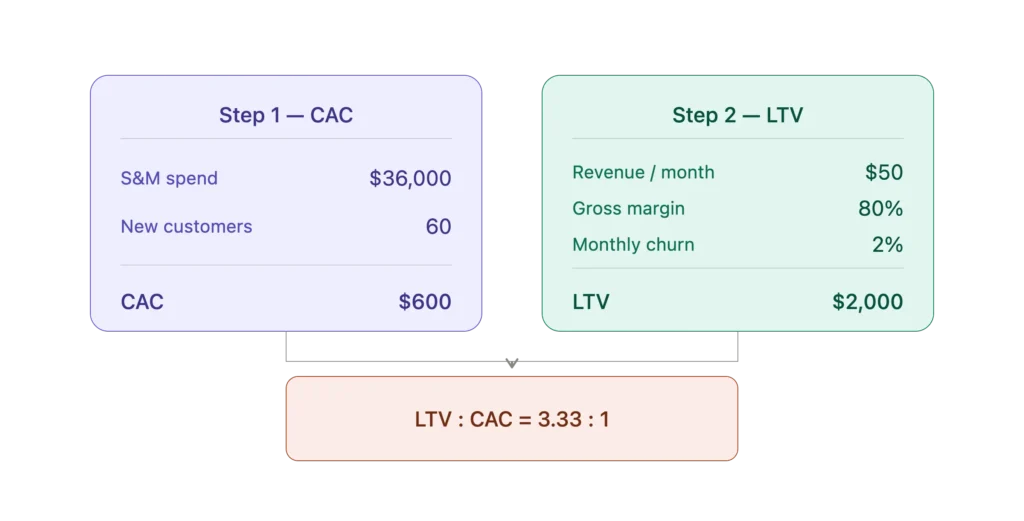
CAC = $36,000 ÷ 60 = $600 per customer
Step 2: Calculate LTV
Your average customer pays $50/month. Your gross margin is 80%. Your monthly churn rate is 2%.
LTV = ($50 × 0.80) ÷ 0.02 = $40 ÷ 0.02 = $2,000
Step 3: Calculate the Ratio
LTV:CAC = $2,000 ÷ $600 = 3.33:1
This means for every dollar spent acquiring a customer, you’re getting back $3.33 in lifetime value. That’s a healthy position — not great, not in danger either.
What Is a Good LTV to CAC Ratio for SaaS?
Here’s where most articles just throw out “3:1 is good” without context. Let’s break it down properly.
| Ratio | What It Means |
|---|---|
| Below 1:1 | You’re losing money on every customer. Fix this before scaling spend further. |
| 1:1 to 2:1 | Break-even to thin margins. Sustainable only short-term, usually a sign CAC is too high or churn is too fast. |
| 3:1 | The commonly cited healthy benchmark. Efficient acquisition with room to reinvest in growth. |
| 4:1 to 5:1 | Strong unit economics — but check if you’re underinvesting in growth. A ratio this high sometimes means you could be spending more to acquire customers faster. |
| Above 5:1 | Often a signal you’re too conservative on marketing spend, not necessarily a “win.” |
The 3:1 number gets repeated everywhere because it roughly balances profitability with growth investment. But the right ratio for you also depends on your growth stage — early-stage startups sometimes accept a lower ratio temporarily to buy market share, while mature SaaS companies push to optimize it higher.

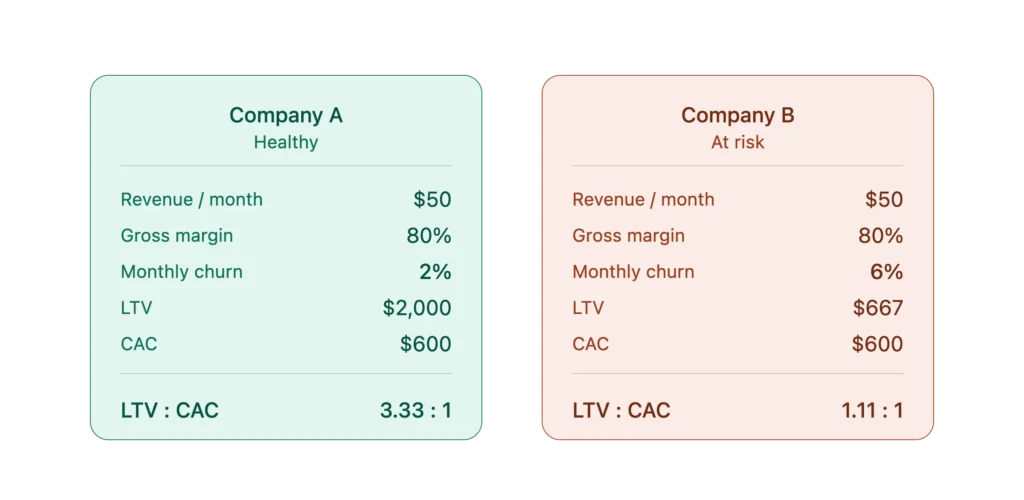
LTV/CAC Example: Comparing Two Scenarios
Seeing this side by side makes the difference between healthy and risky businesses obvious.
| Metric | Company A (Healthy) | Company B (At Risk) |
|---|---|---|
| Monthly Revenue/Customer | $50 | $50 |
| Gross Margin | 80% | 80% |
| Monthly Churn | 2% | 6% |
| LTV | $2,000 | $667 |
| CAC | $600 | $600 |
| LTV:CAC Ratio | 3.33:1 | 1.11:1 |
Same revenue, same CAC — but Company B’s churn rate quietly destroys its unit economics. This is exactly why churn deserves as much attention as acquisition cost. A SaaS business can have great marketing and still be in trouble if customers leave too fast.
How to Improve Your LTV to CAC Ratio
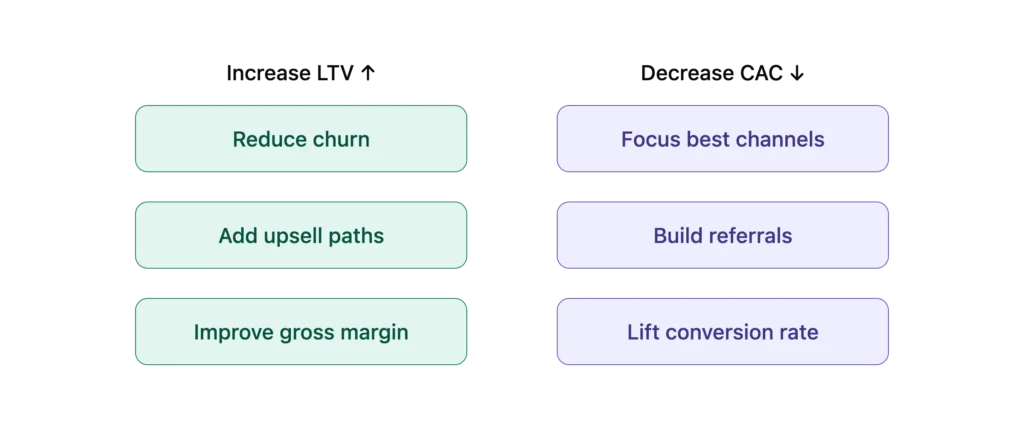
You can move this ratio from two directions — increase LTV, or decrease CAC. Most teams should attack both at once.
To increase LTV:
- Reduce churn through better onboarding — most cancellations happen because customers never reached their “aha moment”
- Introduce upsell and expansion paths (higher-tier plans, add-ons) so existing customers spend more over time
- Improve gross margin by cutting infrastructure costs or automating support
To decrease CAC:
- Double down on channels with the lowest cost per acquisition — check which channel (SEO, referral, paid ads) actually performs best rather than spreading budget evenly
- Build referral or affiliate programs — customer-acquired customers cost far less than ad-acquired ones
- Improve conversion rates on your website so the same traffic produces more paying customers without added spend
Common Mistakes When Calculating LTV to CAC
- Using revenue instead of gross margin in the LTV formula. This overstates LTV and makes your ratio look better than reality.
- Ignoring churn changes over time. A ratio calculated on last year’s churn rate can be dangerously outdated if churn has crept up since.
- Excluding indirect costs from CAC, like management salaries or tools, which makes acquisition look cheaper than it actually is.
- Comparing your ratio to a different-stage company. A Series A startup and a bootstrapped 5-person SaaS shouldn’t be judged by the same benchmark.
FAQ
Is LTV to CAC ratio the same as ROI?
Not exactly. ROI typically measures return over a single period, while LTV:CAC accounts for a customer’s entire projected lifetime with your product.
How often should I calculate my LTV to CAC ratio?
Quarterly is standard for most SaaS companies, though fast-growing or early-stage teams often check monthly since churn and CAC can shift quickly.
What’s a bad LTV to CAC ratio?
Anything below 1:1 means you’re losing money per customer before even counting overhead. Ratios between 1:1 and 2:1 are considered risky long-term.
Does LTV to CAC ratio account for the time value of money?
The basic formula doesn’t. Some more advanced models discount future revenue, but for most operational decision-making, the simple version above is sufficient.
The LTV to CAC ratio isn’t a vanity metric – it’s the clearest signal of whether your growth is actually sustainable or just expensive. Calculate it properly, track it every quarter, and treat any drop below 3:1 as a signal to dig into churn and acquisition costs before scaling spend further.

A SaaS analyst covering product strategy, growth, and customer experience in modern software businesses. Focused on practical insights and real-world SaaS execution.