Retention rarely collapses overnight. In most SaaS businesses, churn begins quietly—weeks or months before a cancellation email ever arrives. Usage drops slightly. A key feature goes untouched. Support conversations change tone. Expansion stalls without explanation. Saas Customer Health Scores exist to surface these early signals before revenue is at risk.
When built correctly, a health score does more than label accounts as “good” or “bad.” It becomes a predictive system—one that helps teams prioritize effort, forecast renewals, and uncover growth opportunities hiding inside existing customers.
What a SaaS Customer Health Scores Really Represents
At its core, a customer health score is a composite indicator. It combines multiple behavioral, financial, and engagement signals into a single view of account stability.
Healthy customers typically show three consistent patterns:
- They use the product in meaningful ways
- They receive ongoing value tied to their original goal
- They maintain active relationships with the product or team
Unhealthy customers rarely disappear suddenly. Instead, they drift—usage becomes sporadic, engagement weakens, and expansion potential quietly fades.
SaaS Customer Health Scores exist to make that drift visible.
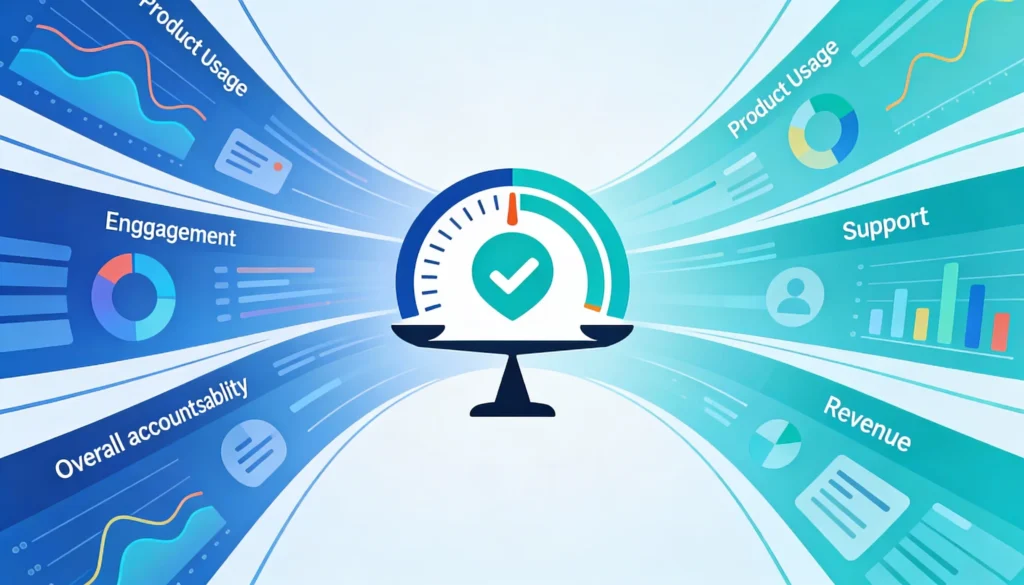
Why SaaS Teams Use Health Scores to Predict Retention
Most churn prediction failures happen for one reason: teams react too late.
By the time a renewal conversation begins, the outcome is often already decided, which is why proactive retention strategies need to start much earlier.
Teams use SaaS Customer Health Scores to:
- Identify accounts at risk weeks before renewal
- Spot expansion-ready customers early
- Allocate customer success resources efficiently
- Separate temporary friction from structural churn risk
The strongest systems do not ask, “Is this customer happy?”
They ask, “Is this customer still receiving measurable value?”
The Core Components of a Reliable Health Score
While implementations vary, effective saas customer health scores almost always include four foundational categories.
Product Usage Signals
Usage is the backbone of any health model, but raw activity alone is misleading without context from early activation metrics.
Strong indicators focus on:
- Frequency of core feature usage
- Depth of workflows completed
- Consistency over time, not spikes
A customer logging in daily but avoiding the product’s primary value driver may be less healthy than one logging in weekly with focused intent.
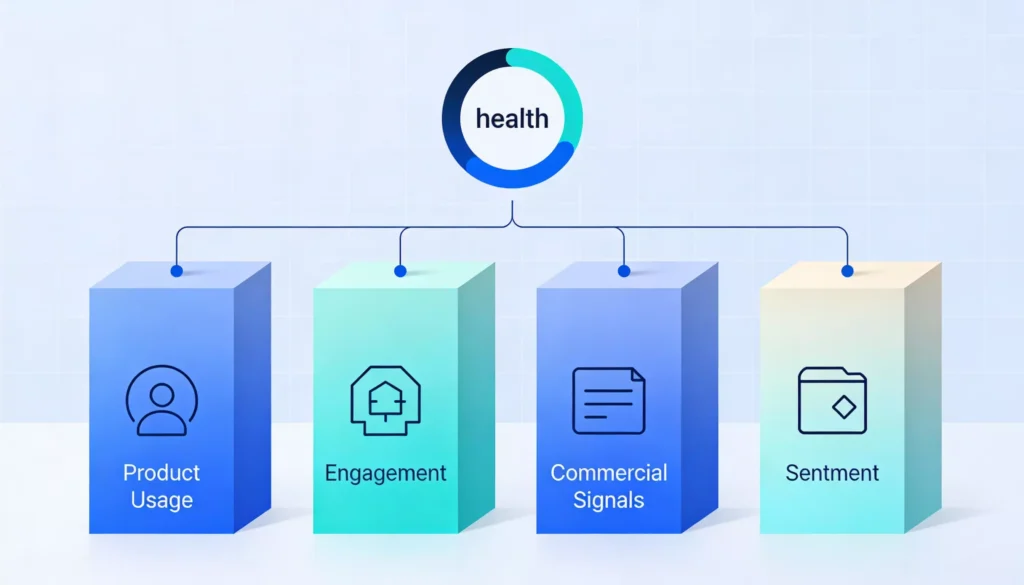
Engagement & Relationship Signals
Engagement reveals how connected a customer remains to the product and brand.
Common signals include:
- Support interaction patterns
- Responsiveness to onboarding or success check-ins
- Educational content engagement
- In-app guidance completion
Changes in engagement velocity often precede churn before usage metrics decline.
Commercial & Expansion Signals
Revenue behavior matters, but context matters more.
Useful indicators include:
- License utilization vs purchased capacity
- Expansion conversations initiated by the customer
- Add-on adoption trends
- Payment behavior consistency
A flat account is not necessarily unhealthy—but a flat account combined with declining usage often is.
Sentiment & Feedback Signals
Qualitative data plays a supporting role.
Inputs may include:
- NPS or CSAT trends
- Survey participation patterns
- Support ticket sentiment shifts
- Verbatim feedback themes
Sentiment rarely predicts churn alone, but it strengthens prediction when paired with behavioral data.
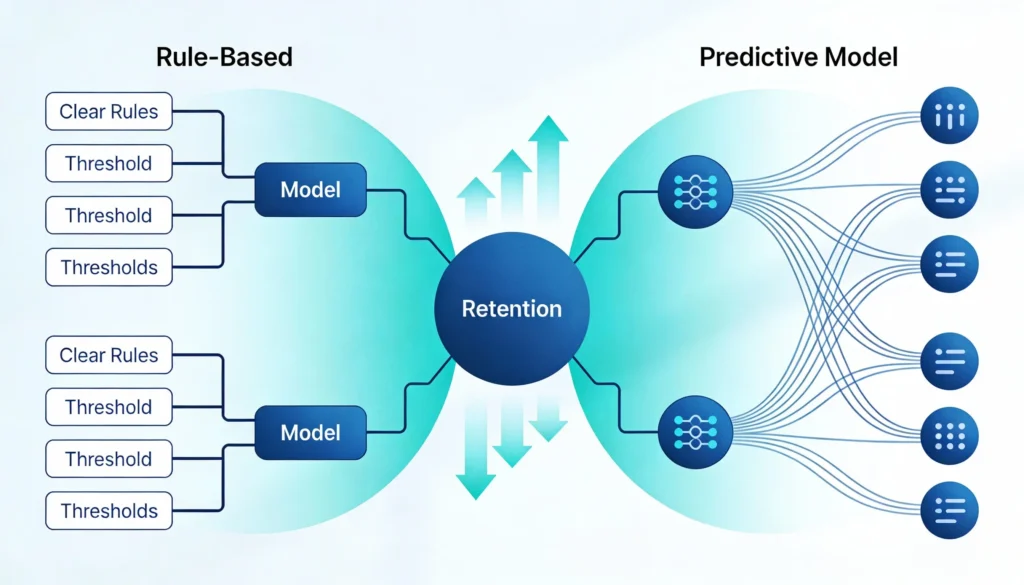
Predictive vs Rule-Based Health Score Models
Not all health scores function the same way. Most SaaS teams fall into one of two camps.
Rule-Based Models
Rule-based systems assign weights manually:
- Usage above threshold = green
- Declining engagement = yellow
- No activity + payment issues = red
These models are transparent and easy to explain. They work well for early-stage SaaS teams or products with clear usage paths.
However, they rely heavily on assumptions and require frequent manual tuning.
Predictive Models
Predictive models analyze historical churn and expansion data to identify patterns humans may miss.
Instead of asking “Is usage down?” they ask:
- Which behavior combinations preceded churn?
- Which signals correlated with expansion?
- How early did warning signs appear?
Predictive models improve accuracy but require:
- Sufficient historical data
- Clean event tracking
- Ongoing validation
Many mature SaaS teams combine both approaches—starting rule-based, then layering predictive insights over time.
How Health Scores Guide Retention Strategy
A health score is only useful if it changes behavior.
High-performing teams use scores to:
- Trigger proactive success outreach
- Adjust onboarding paths for at-risk segments
- Prioritize renewal preparation
- Inform product roadmap discussions
Rather than treating churn as a customer problem, health scores help teams identify systemic value gaps inside the product experience.
Using Health Scores to Drive Expansion Growth
Retention is only half the equation. Health scores also reveal where growth already exists.
Expansion-ready accounts typically show:
- High core feature adoption
- Increasing usage breadth
- Stable engagement patterns
- Underutilized plan limits
By surfacing these signals early, teams move from reactive upselling to timely value-based expansion.
The result is growth that feels earned—not forced.
Common Mistakes That Undermine Health Scores
Many health score systems fail quietly. Common pitfalls include:
- Overweighting login frequency
- Treating all customers as equal despite segment differences
- Ignoring lifecycle stage context
- Failing to revisit scoring logic as the product evolves
A health score should evolve alongside the product. Static models age quickly.
Health Scores as a Strategic System, Not a Number
The most effective SaaS teams do not obsess over the score itself. They focus on the signals behind it.
When health scores are treated as:
- A shared language across teams
- A feedback loop for product decisions
- A prioritization engine for success efforts
They become more than a metric. They become infrastructure.
Customer Health Scores do not predict the future perfectly. But they reduce uncertainty—turning silent churn risk into visible signals teams can act on.
In SaaS, retention and growth are rarely about saving failing customers. They are about recognizing value alignment early and reinforcing it consistently.
Health scores simply make that work possible at scale.

A SaaS analyst covering product strategy, growth, and customer experience in modern software businesses. Focused on practical insights and real-world SaaS execution.