
Two SaaS companies both spend $500,000 on sales and marketing in a quarter. One ends the quarter with $200,000 in new recurring revenue. The other ends with $600,000. Same spend, wildly different outcomes. The Magic Number is what puts a hard figure on that difference, and it’s one of the most underused metrics in early-stage SaaS.
This guide covers the saas magic number formula, walks through a real saas magic number example, and answers the common questions people search around it, including how it relates to Rule of 40 and the “3-3-2-2-2” growth framework.
What Is the SaaS Magic Number?
The SaaS Magic Number measures sales efficiency. Specifically, it tells you how much new recurring revenue you generate for every dollar spent on sales and marketing in the prior period.
In plain terms: is your sales and marketing spend actually converting into growth, or are you spending more and more just to stay in place?
SaaS Magic Number Formula
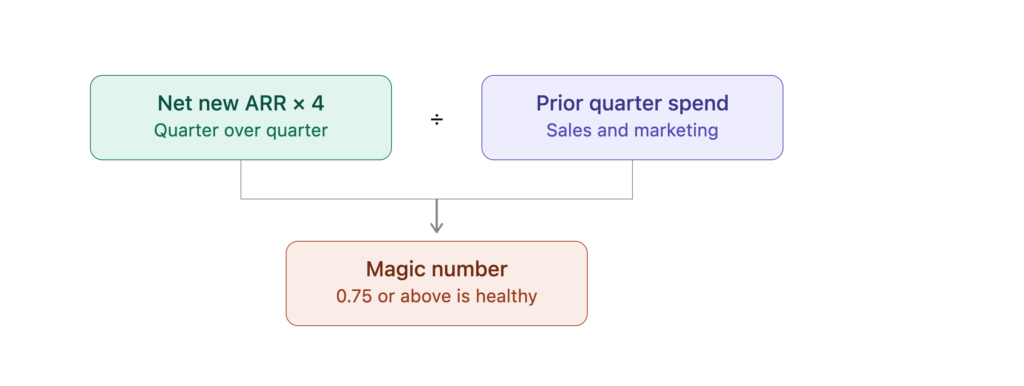
Magic Number = (Current Quarter ARR – Previous Quarter ARR) x 4 ÷ Previous Quarter Sales & Marketing Spend
A quick breakdown of why this formula looks the way it does:
- You take the increase in ARR (Annual Recurring Revenue) quarter over quarter
- Multiply by 4 to annualize the quarterly gain
- Divide by the sales and marketing spend from the previous quarter, since that spend is what drove the current quarter’s growth, not this quarter’s spend
Some versions of this formula use net new ARR without multiplying by 4, so always check which version you’re comparing against when reading benchmarks.
SaaS Magic Number Example (Step by Step)
Say your company had these numbers over two quarters.
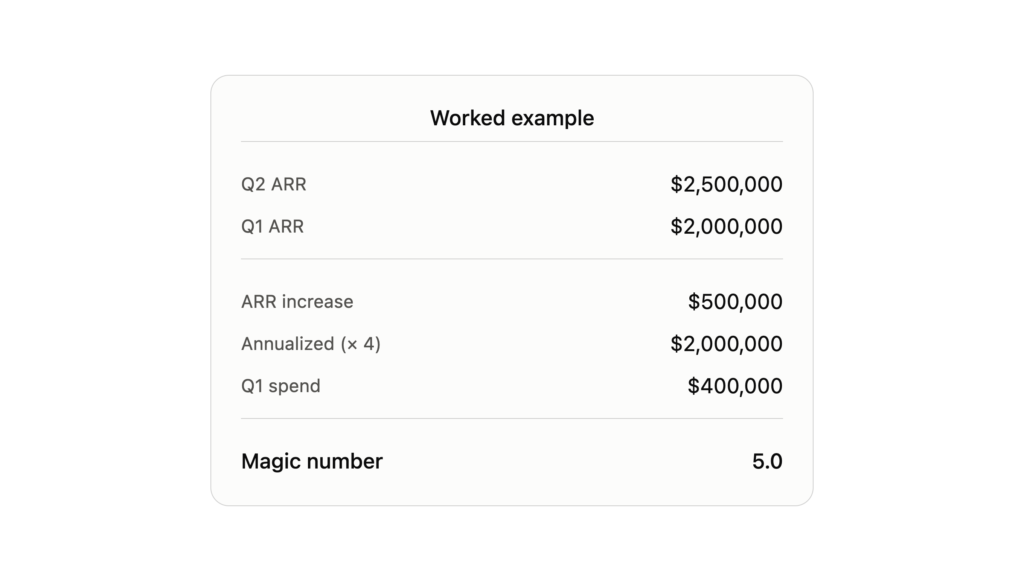
Q1 ARR: $2,000,000 Q2 ARR: $2,500,000 Q1 Sales & Marketing Spend: $400,000
Step 1: Find the ARR increase. $2,500,000 – $2,000,000 = $500,000
Step 2: Annualize it. $500,000 x 4 = $2,000,000
Step 3: Divide by prior quarter’s sales and marketing spend. $2,000,000 ÷ $400,000 = 5.0
A Magic Number of 5.0 is unusually strong. Most companies won’t see numbers this high, but it’s useful to walk through the math with round numbers before applying it to your own, messier data.
What Is a Good SaaS Magic Number?
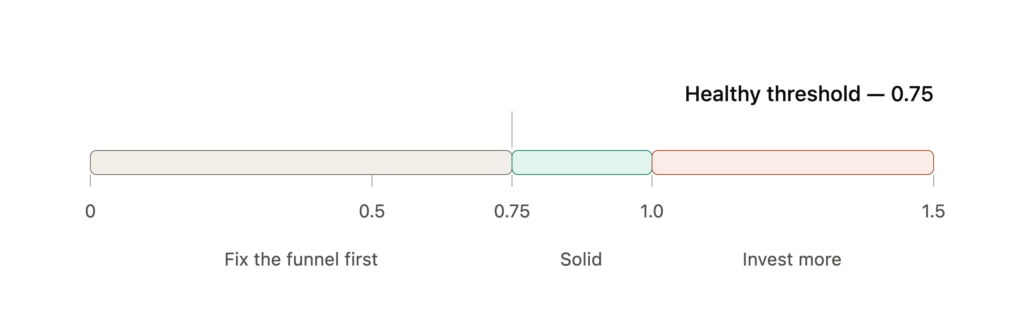
Here’s where most short answers online oversimplify things. The commonly cited benchmarks are:
| Magic Number | What It Means |
|---|---|
| Below 0.5 | Sales and marketing spend isn’t converting efficiently. Slow down spend and fix the funnel before scaling further. |
| 0.5 to 0.75 | Acceptable, but investors will want to see improvement before increasing investment. |
| 0.75 to 1.0 | Solid efficiency. Many SaaS companies operating well fall in this range. |
| Above 1.0 | Strong efficiency. A good signal to increase sales and marketing investment, since each dollar is producing more than a dollar of new ARR. |
| Above 1.5 to 2.0 | Excellent, often seen in companies with product led growth or strong word of mouth reducing paid acquisition dependence. |
So to directly answer “what is a good magic number for SaaS”: most benchmarks put the healthy threshold at 0.75 and above, with 1.0+ considered a green light to invest more aggressively in growth.
Magic Number vs Sales Efficiency: Are They the Same Thing?
This is a common point of confusion. “Sales efficiency” is often used as a broader umbrella term, while “Magic Number” refers specifically to this ARR-based formula. In practice, many teams use the terms interchangeably, but sales efficiency can also refer to related metrics like CAC payback period or gross margin adjusted CAC. If someone hands you a “sales efficiency” number without specifying the formula, ask which calculation they used before comparing it to any benchmark.
What Is the Rule of 40 in SaaS Metrics?
The Rule of 40 is a related but different metric. It adds your revenue growth rate to your profit margin, and a combined score of 40 or higher is considered healthy. Where the Magic Number measures how efficiently your sales and marketing spend converts to new revenue, Rule of 40 measures the balance between overall growth and profitability across the whole business.
Think of it this way: Magic Number zooms in on your go-to-market engine specifically, while Rule of 40 zooms out to the entire business. A company can have a strong Magic Number but a weak Rule of 40 score if costs outside of sales and marketing (like R&D or infrastructure) are out of control.
What Is the 3-3-2-2-2 Rule of SaaS?
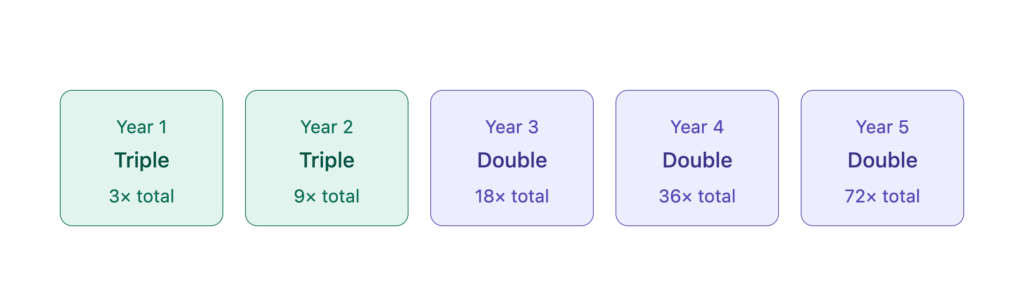
This is a growth benchmark framework, separate from the Magic Number, that describes an ideal revenue growth trajectory for SaaS companies over several years:
- Triple revenue in year one
- Triple revenue in year two
- Double revenue in year three
- Double revenue in year four
- Double revenue in year five
It originated as a rough model for what “great” SaaS growth looks like at each stage, popularized in venture capital circles as a benchmark for top-quartile companies. It doesn’t measure efficiency the way the Magic Number does. It’s purely a growth rate expectation over time, useful for setting long-term targets rather than judging quarterly sales performance.
Magic Number Calculator: Do You Need One?
Given the formula only needs three inputs (current ARR, previous ARR, and previous quarter’s sales and marketing spend), a dedicated calculator tool isn’t strictly necessary. A simple spreadsheet with the formula built in works just as well, and lets you track the trend over multiple quarters, which matters more than any single quarter’s score.
If you want to track it properly:
- Create a row for each quarter
- Add columns for ARR, quarter over quarter ARR change, and sales and marketing spend
- Build the formula once and drag it down as new quarters get added
Watching the trend over 4-6 quarters tells you far more than one isolated number ever will.
Common Mistakes When Calculating Magic Number
- Using current quarter spend instead of previous quarter spend. The formula is built around the idea that spend has a lag effect on revenue, so using the wrong period’s spend distorts the number completely.
- Ignoring one time revenue spikes. A single large annual contract landing in one quarter can make the Magic Number look artificially high. Smooth out unusual one time deals before drawing conclusions.
- Comparing your number to a different business model. A usage based pricing SaaS company and a flat subscription SaaS company can have very different natural Magic Number ranges.
What is a good magic number for SaaS? Most benchmarks consider 0.75 or higher healthy, with 1.0 and above signaling it’s a good time to increase sales and marketing investment.
What is the magic number in software? Same concept as SaaS. It measures how much new annual recurring revenue a software company generates relative to what it spent on sales and marketing in the prior period.
How is Magic Number different from CAC payback period? CAC payback period tells you how many months it takes to earn back what you spent acquiring a single customer. Magic Number looks at overall sales and marketing efficiency across the whole business, not per customer.
Can a negative ARR quarter produce a negative Magic Number? Yes. If ARR shrinks quarter over quarter due to churn outweighing new business, the Magic Number will be negative, which is a strong signal to address retention before scaling acquisition spend.
The Magic Number won’t tell you everything about your business, but it answers one question clearly: is your sales and marketing spend actually working. Track it every quarter alongside Rule of 40 and LTV to CAC ratio, and you’ll have a much clearer picture of whether your growth is efficient or just expensive.

A SaaS analyst covering product strategy, growth, and customer experience in modern software businesses. Focused on practical insights and real-world SaaS execution.