
A founder pitches a board with 90% revenue growth and gets applauded. Another pitches 35% growth with strong margins and gets ignored. Six months later, the first company is burning cash it can’t replace, and the second is quietly profitable. Growth alone never told the whole story — and that’s exactly the gap the Rule of 40 in SaaS was built to close.
This guide covers the rule of 40 saas formula, walks through a rule of 40 saas example, and answers the question people keep typing into Google: is this metric only for SaaS, or does it apply more broadly?
Want to check your own number? Flowjam’s free Rule of 40 calculator includes 2026 benchmarks by stage.
What Is the Rule of 40 in SaaS?
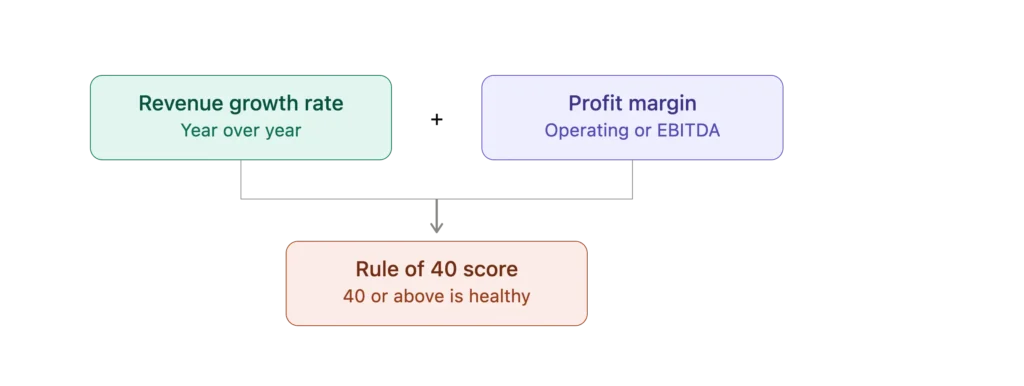
The Rule of 40 is a simple benchmark that says a healthy software company’s growth rate plus profit margin should add up to 40% or more. It’s not a hard rule in the legal sense – more of an industry gut-check investors and operators use to sanity-test whether a company is growing responsibly or just growing expensively.
Rule of 40 in SaaS Formula
Here’s the actual rule of 40 formula:
Rule of 40 Score = Revenue Growth Rate (%) + Profit Margin (%)
The “profit margin” part isn’t fixed – companies use different variations depending on what data they have available:
- Operating margin (most common in public company reporting)
- EBITDA margin
- Free cash flow margin
Whichever margin you use, be consistent every time you calculate it, so your trend over time actually means something.
Rule of 40 Example (Step by Step)
Let’s say your SaaS company had:
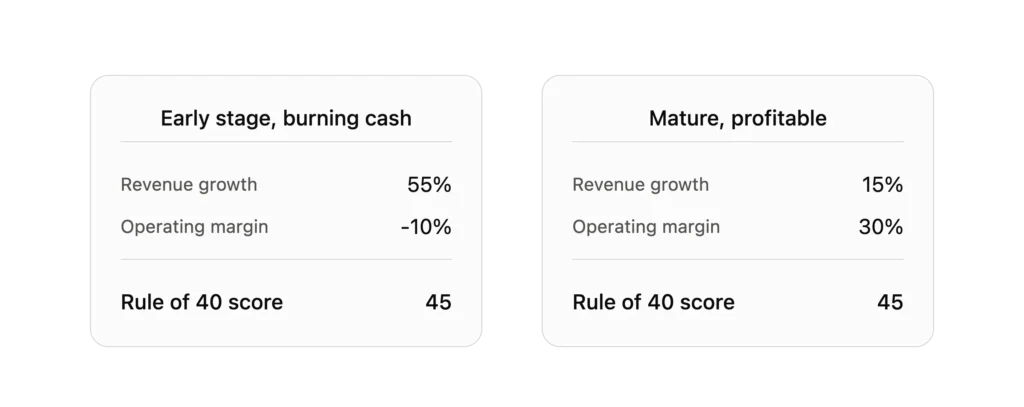
- Revenue growth of 55% year-over-year
- Operating margin of -10% (you’re still investing heavily and running at a loss)
Rule of 40 Score = 55 + (-10) = 45
Even though you’re unprofitable, a 55% growth rate is strong enough to pull the combined score above 40. This is normal and expected for early-stage, high-growth SaaS companies — investors don’t expect profitability yet, but they do expect growth to justify the losses.
Now compare a more mature company:
- Revenue growth of 15%
- Operating margin of 30%
Rule of 40 Score = 15 + 30 = 45
Same score, completely different business profile. One is a fast-growing, cash-burning startup. The other is a stable, profitable, slower-growing company. Both pass the Rule of 40 — which is exactly why this metric should never be read in isolation from your growth stage.
Is Rule of 40 Only for SaaS?
Short answer: no, though it’s most associated with SaaS. The metric originated in software and venture capital circles because SaaS businesses have predictable recurring revenue, making growth and margin trade-offs easy to track quarter over quarter.
That said, the same growth-plus-profitability logic gets applied informally in other tech-adjacent sectors — fintech, subscription-based consumer apps, and increasingly, AI infrastructure companies. Outside of software, it’s used far less often because traditional industries don’t have the same recurring revenue structures that make the formula meaningful.
Rule of 40 Palantir: A Real-World Example
Public companies make great case studies because their financials are disclosed. Palantir reported a Rule of 40 score of 145% in Q1 2026, driven by 85% revenue growth combined with a 60% adjusted operating margin — a score most software companies never get close to.
What makes this notable is that Palantir’s growth rate was still around 70% just a couple of quarters earlier, with a Rule of 40 score in the 127% range. The trend matters as much as the single number — a company climbing steadily on both growth and margin is a very different story than one hitting a high score once and plateauing.
For context, most subscription SaaS companies operate nowhere near this range. A score of 145 is exceptional even among high-performing public tech companies — it’s a useful reminder that the “40” benchmark is a floor, not a target ceiling.
Rule of 40 SaaS Companies List — How to Build Your Own Benchmark
Rather than relying on a fixed list (public company metrics shift every quarter), the more useful skill is knowing where to check current numbers yourself:
- Public SaaS companies disclose growth and margin figures in quarterly earnings reports and investor presentations
- Sites like Investor Relations pages, SEC filings, or financial data platforms (rather than aggregator blog posts) give you the most current numbers
- When comparing companies, always check which margin definition they’re using — operating margin and free cash flow margin can produce very different scores for the same company
If you’re looking for a rule of 40 saas pdf to reference internally, the cleanest approach is building your own one-pager: track your own growth rate and margin quarter over quarter, plus 2-3 public comparable companies in your space, and update it every earnings cycle.

How to Use Rule of 40 in Your Own SaaS Business
- Track it quarterly, not annually — SaaS metrics shift fast enough that annual tracking hides real problems
- Don’t chase the number for its own sake — a company inflating growth through unsustainable discounting to hit “40” is worse off than one honestly scoring 35
- Use it alongside other metrics like LTV:CAC ratio and churn rate — Rule of 40 tells you growth-vs-profitability balance, but says nothing about retention quality on its own
- Segment it by revenue type if you can — new business growth and expansion revenue behave differently, and blending them can mask which one is actually driving your score
Common Mistakes
- Comparing your early-stage startup’s score directly to a public company’s. Stage matters enormously — a Series A company burning cash to grow fast shouldn’t benchmark itself against a profitable, mature SaaS company.
- Using inconsistent margin definitions between quarters. Switching from EBITDA margin to operating margin mid-year makes your trend line meaningless.
- Treating 40 as a pass/fail line. A company at 38 with improving trends is often in better shape than one that hit 42 once and is now declining.
FAQ
What counts as a good Rule of 40 score?
40 or above is considered healthy. Scores in the 50-60 range are strong, and anything above 100 (like Palantir’s recent quarters) is exceptional and rare.
Can a company have a negative Rule of 40 score?
Yes – if growth is low and the company is unprofitable, the combined score can fall below zero. This usually signals the business needs to either accelerate growth or cut costs.
Does Rule of 40 apply to early-stage startups without revenue yet?
Not meaningfully. The metric only works once there’s a stable revenue base to measure growth and margin against – pre-revenue or very early-stage companies should focus on other milestones first.
Is Rule of 40 the same as the SaaS Magic Number?
No, they measure different things. Rule of 40 balances overall growth and profitability, while the Magic Number specifically measures sales efficiency – how much new revenue you get per dollar of sales and marketing spend.
The Rule of 40 works because it forces a conversation that raw growth numbers avoid: growth at what cost? Whether you’re a five-person SaaS startup or benchmarking against public companies posting record scores, the real value isn’t hitting 40 – it’s understanding your own trade-off between growth and profitability, and making that trade-off on purpose.

A SaaS analyst covering product strategy, growth, and customer experience in modern software businesses. Focused on practical insights and real-world SaaS execution.