In the early stages of a SaaS business, acquisition often feels like the main growth lever. New signups validate demand, dashboards show rising traffic, and teams focus heavily on bringing more users into the funnel. This early focus explains why SaaS retention matters more than acquisition only later, when companies mature and face a hard truth: acquisition alone does not create sustainable, long-term growth.
Retention plays a far more critical role in long-term SaaS success. It reflects whether users continue to find value after the first interaction and whether the product is strong enough to support consistent engagement over time.
This article explains why retention matters more than acquisition in SaaS and how teams should think about it as their product scales.
Acquisition Brings Attention, Retention Builds Businesses
Acquisition answers a simple question:
Can we attract users?
Retention answers a harder one: Do users stay because the product is genuinely useful?
A SaaS company can acquire users through marketing spend, promotions, or partnerships. But if users fail to return, the cost of acquisition increases while lifetime value remains low. Over time, this imbalance limits growth and increases pressure on marketing budgets.
Retention, on the other hand, compounds. Each retained user reduces dependency on constant acquisition and creates a stronger base for expansion.

The Cost Problem With Acquisition-Heavy Growth
Focusing primarily on acquisition introduces several structural problems:
- Rising customer acquisition costs over time
- Short customer lifecycles that limit revenue predictability
- Pressure to discount pricing to maintain growth
- High churn masking underlying product issues
These challenges often appear only after early traction, when scaling efforts expose weaknesses in the product experience.
Retention as a Signal of Product Value
Retention is one of the clearest indicators that a product delivers ongoing value. When users return consistently, it suggests the product solves a recurring problem rather than a one-time need.
SaaS teams often evaluate retention alongside activation and retention signals to understand whether early engagement leads to long-term usage. Weak retention usually points to friction in onboarding, unclear value propositions, or features that fail to integrate into daily workflows.
The Role of Onboarding in Retention
Retention does not begin after weeks of usage. It often starts during the first interaction.
A poor user onboarding experience can prevent users from ever reaching meaningful value, even if the product itself is strong. Confusing setup steps, unclear guidance, or missing context increase early drop-off rates.
Improving onboarding does not guarantee retention, but weak onboarding almost always limits it.

Retention Improves Growth Efficiency
When retention is strong, every acquisition effort becomes more efficient. Marketing spend generates users who stay longer, support costs stabilize, and expansion opportunities increase.
High-retention SaaS companies benefit from:
- More predictable revenue patterns
- Stronger word-of-mouth growth
- Higher tolerance for pricing adjustments
- Better data for product decision-making
In this environment, growth becomes less reactive and more intentional.
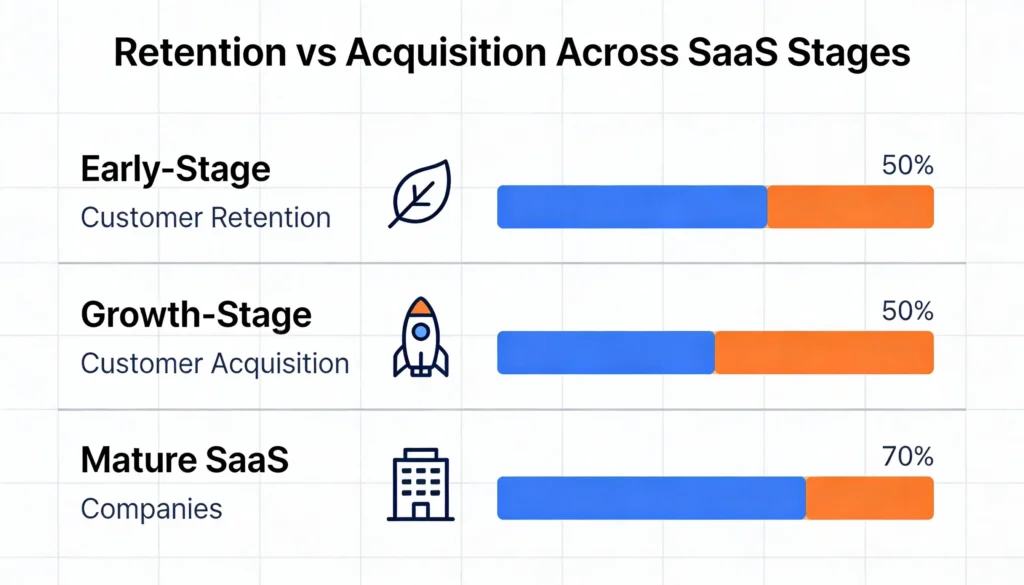
Retention vs Acquisition Across SaaS Stages
The importance of retention increases as a SaaS company evolves.
- Early stage: Acquisition validates demand, retention reveals product weaknesses
- Post-traction: Retention determines whether growth is sustainable
- Scaling stage: Retention drives expansion and profitability
After initial traction, teams that continue prioritizing acquisition over retention often struggle to scale efficiently.
Measuring Retention Beyond Simple Churn Rates
Retention is not just about whether users leave. It also involves how they engage while they stay.
Common retention indicators include:
- Frequency of active usage
- Feature adoption depth
- Account expansion signals
- Consistency across user cohorts
These metrics help teams understand whether retention reflects real engagement or passive usage.
Acquisition may start growth, but retention sustains it. SaaS companies that prioritize retention build stronger products, reduce dependency on marketing spend, and create more predictable long-term outcomes. As products mature, the question shifts from how many users can we attract to how many users continue to succeed. In SaaS, retention is not just a metric—it is a reflection of product quality and business health.

A SaaS analyst covering product strategy, growth, and customer experience in modern software businesses. Focused on practical insights and real-world SaaS execution.