SaaS growth is often treated as a race for faster acquisition. More leads, more trials, more signups. But companies that scale sustainably don’t rely on constant acquisition alone. They design systems where growth feeds itself over time. These systems are known as Sustainable Growth Loops.
A sustainable growth loop focuses on long-term momentum rather than short-term spikes. Instead of asking, “How do we get more users this month?”, it asks, “How does each new user help us grow tomorrow?
What Is a SaaS Growth Loop?
A growth loop is a repeatable cycle where one action naturally leads to another, reinforcing growth without requiring proportional increases in spend.
For example:
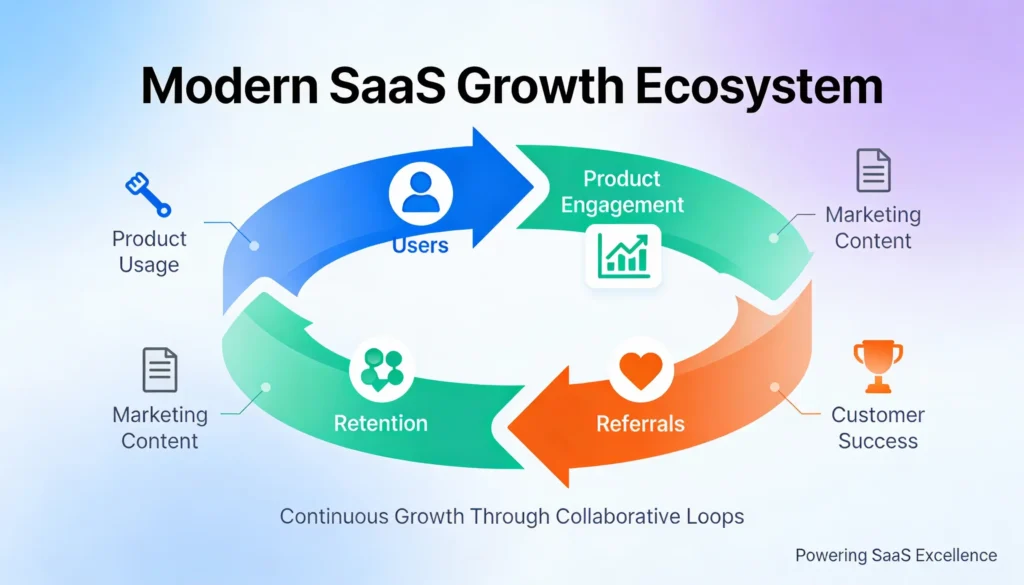
- A user gets value from the product
- That value increases engagement or retention
- Engagement leads to expansion, referrals, or advocacy
- New users enter the system with higher trust
Unlike funnels, loops don’t end. They compound.
Why Sustainable Growth Matters More Than Speed
Fast growth without structure often hides deeper problems. Acquisition can inflate metrics temporarily, but weak retention and poor onboarding eventually catch up.
This is why many SaaS teams are shifting focus from pure acquisition toward retention-driven growth strategies, where existing users play an active role in expansion. When growth is built into the product experience, it becomes easier to scale without burning resources.
Core Types of Sustainable Growth Loops
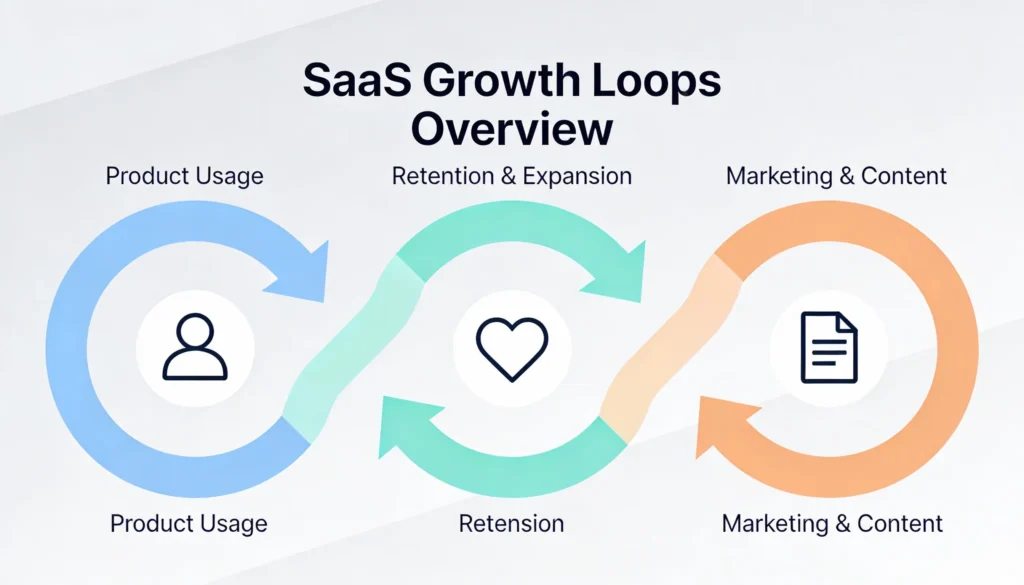
1. Product Usage Loops
When regular usage creates more value, users naturally stay longer and expand their use cases. Strong onboarding and intuitive workflows are critical here.
Teams that avoid common onboarding mistakes often see higher activation and longer customer lifecycles.
2. Retention and Expansion Loops
Retention is often a stronger indicator of health than new signups. Companies that track growth beyond revenue metrics such as feature adoption, engagement depth, and customer success signals are better positioned to expand accounts organically.
Retention-focused teams consistently outperform acquisition-heavy strategies in the long run.
3. Marketing and Content Loops
Educational content, case studies, and product insights help users understand the product more deeply. Over time, this builds trust and positions the brand as a long-term partner rather than a tool.
Growth and marketing overlap here, but the goal isn’t promotion it’s value reinforcement.
Aligning Teams Around Growth Loops
Growth loops only work when product, marketing, and customer experience teams operate with shared goals. Siloed execution often breaks the loop.
Product teams must understand how usage drives retention. Marketing teams need clarity on how education supports adoption. Support teams play a key role in reinforcing value during critical moments.
When these teams align, growth becomes predictable rather than reactive.
Measuring the Health of a Growth Loop
Sustainable growth isn’t measured by one metric. Instead, companies track:
- Activation rates
- Feature adoption trends
- Retention curves
- Expansion behavior
Revenue follows when these signals stay strong. Teams that rely only on topline revenue often miss early warnings.
Sustainable SaaS growth isn’t about chasing faster results. It’s about building systems that improve with every user interaction. Sustainable Growth Loops create momentum that compounds over time, allowing companies to scale with confidence rather than pressure.
The strongest SaaS businesses aren’t growing harder they’re growing smarter.

A SaaS analyst covering product strategy, growth, and customer experience in modern software businesses. Focused on practical insights and real-world SaaS execution.