A founder spends six months building an enterprise sales team, hires reps, sets up a CRM, and closes exactly two deals. Meanwhile, a competitor with no salespeople at all lets users try the product for free, and word of mouth alone gets them to $1M ARR. Both are legitimate SaaS growth strategies. The problem starts when a company picks the wrong one for what it’s actually selling.
This guide breaks down product led growth vs sales led growth, with real company examples, so you can figure out which model actually fits your product instead of copying whatever a random blog post recommends.
What Does Product Led Mean?
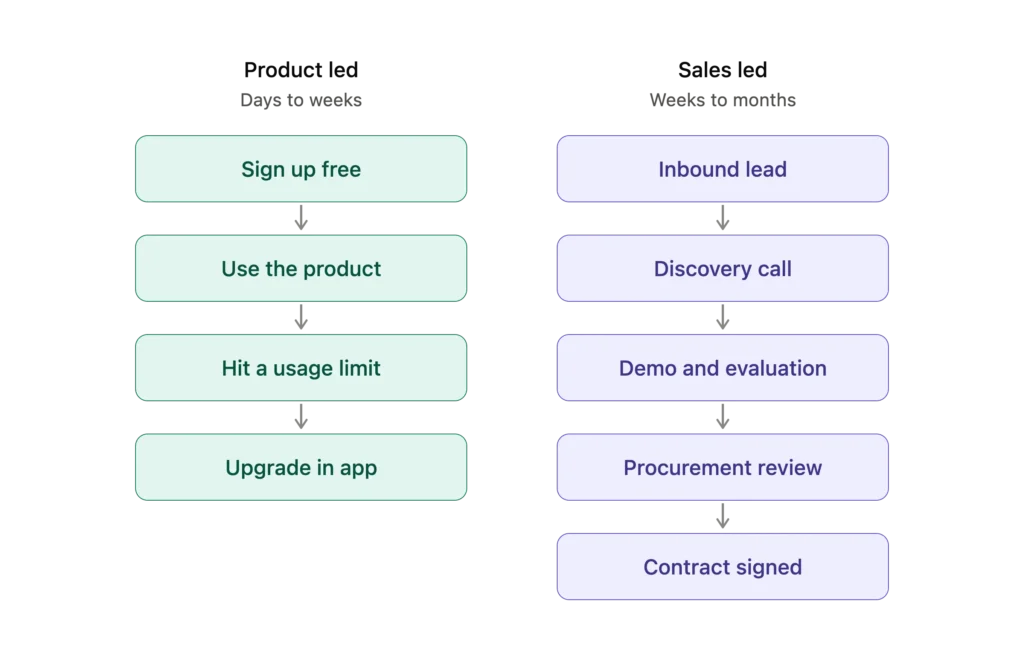
Product led growth (PLG) means the product itself drives acquisition, conversion, and expansion, largely without a traditional sales team involved in the early stages. Users can sign up, try the product, and often start paying for it without ever talking to a human on the vendor’s side.
The product does the selling. Onboarding, free trials, freemium tiers, and in-app upgrade prompts replace what a sales rep would traditionally handle.
Product Led Growth vs Sales Led Growth: Side by Side
| Factor | Product Led Growth | Sales Led Growth |
|---|---|---|
| Primary driver of conversion | The product itself (free trial, freemium) | Sales reps and demos |
| Typical price point | Lower, often under $100/month per seat | Higher, often $10K+ annual contracts |
| Sales cycle length | Days to weeks | Weeks to many months |
| Buyer | Often an individual user or small team | Multiple stakeholders, procurement involved |
| Customer acquisition cost | Lower per customer | Higher per customer |
| Best fit | Simple, self-serve products with fast time to value | Complex products needing customization or integration |

Product Led vs Sales Led Companies: Real Examples
Seeing this play out in real companies makes the distinction clearer.
Product Led Growth Examples
- Slack grew initially through teams adopting it organically, often without any input from IT or procurement, before expanding into paid enterprise plans
- Dropbox used a freemium model combined with a referral program that rewarded users with extra storage for inviting others, driving viral growth with almost no sales team involvement early on
- Notion relies heavily on individual users adopting the free tier, then teams naturally expanding usage until upgrading to a paid plan becomes necessary
Sales Led Growth Examples
- Salesforce, especially at the enterprise tier, relies on account executives, solution engineers, and long sales cycles involving multiple departments
- Oracle enterprise software deals typically involve extensive negotiation, custom contracts, and dedicated account management
- Workday sells HR and finance software that requires deep integration work, making sales led engagement necessary to scope implementation before a deal closes
Many companies eventually blend both. Slack, for example, added enterprise sales motions once it needed to close larger organizational deals that required custom security reviews and procurement approval, something a purely self-serve model struggles to handle.
What Is the Difference Between Product-Led Growth and Sales-Led Growth?
The core difference comes down to who does the convincing. In PLG, the product itself proves its value fast enough that a prospective customer doesn’t need someone explaining it to them. In SLG, the value proposition is often complex enough, or the price high enough, that a sales conversation is necessary to build trust and address specific concerns before someone commits.
Another way to frame it: PLG optimizes for volume with lower touch per customer, while SLG optimizes for deal size with much higher touch per customer.
How to Choose Between PLG and SLG
Ask these questions honestly about your own product before committing to a model.
Choose product led growth if:
- Your product delivers value within minutes of signup, not weeks
- Your price point is low enough that individuals or small teams can expense it without approval
- Your target user can self-onboard without training or implementation support
Choose sales led growth if:
- Your product requires custom implementation, integration, or security review
- Your buyer isn’t the end user, meaning you need to convince a different stakeholder than the person who’ll actually use the product
- Your price point is high enough that a serious buying decision requires multiple people to sign off
Many successful SaaS companies actually run a hybrid model, using PLG to drive initial adoption and land smaller accounts, then layering in a sales team once usage signals show an account is ready to expand into a bigger contract.
Marketing-Led Growth: Where Does It Fit?
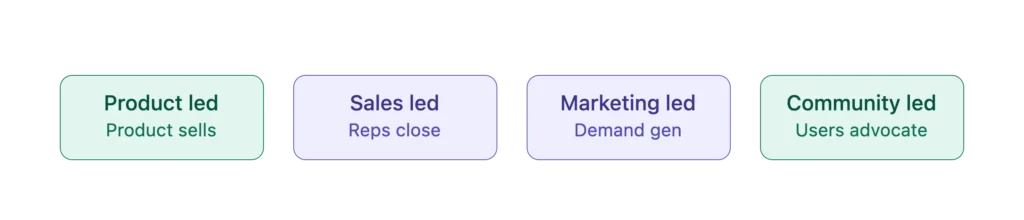
Marketing-led growth is a related but distinct model where marketing campaigns, content, and demand generation drive the top of funnel, then hand off leads to either a product experience or a sales team to close. It’s not mutually exclusive with PLG or SLG. In practice, marketing led growth often feeds both models, generating awareness and traffic that eventually converts either through self-serve signup or a sales conversation, depending on how the company is structured.
What Are the 4 Types of Growth?
SaaS companies generally combine four broad growth motions:
- Product led growth, where the product itself drives adoption and expansion
- Sales led growth, where a sales team drives the buying decision directly
- Marketing led growth, where demand generation and content drive top of funnel awareness before conversion
- Community led growth, where an engaged user community drives adoption through advocacy, word of mouth, and peer recommendations rather than paid channels
Most mature SaaS companies use a blend of two or more of these rather than relying on a single motion exclusively.

What Is the 3-3-3 Rule in Sales?
The 3-3-3 rule is a time management framework often used by sales teams to structure a rep’s day or week. It generally breaks work into three blocks: prospecting new leads, following up on active deals, and administrative or pipeline management work, each getting a dedicated portion of time rather than letting one task dominate the entire day. Different teams adapt the exact split to their own workflow, but the underlying idea is preventing reps from spending all their time on one activity, like chasing new leads, while neglecting deals already in progress.
What Are the 5 C’s of Sales?
The 5 C’s of sales is a framework used to evaluate whether a deal or customer relationship is likely to succeed. While variations exist across different sales methodologies, the common thread across most versions includes:
- Customer: understanding who they are and what they actually need
- Company: assessing whether the buyer’s organization is a good fit for your product
- Competitors: knowing who else the buyer is considering and why
- Collaborators: identifying internal stakeholders who influence the buying decision
- Conditions: external factors like budget cycles, market conditions, or timing that affect whether a deal closes
This framework is more common in sales led environments, where understanding the full buying context matters more than in a self-serve PLG motion.
Common Mistakes When Choosing a Growth Model
- Forcing a low-touch product into a heavy sales process. If your product is simple and cheap, adding a lengthy sales cycle just slows down adoption without adding real value for the buyer.
- Trying pure PLG for a complex enterprise product. If your product genuinely needs implementation support or executive buy-in, skipping sales entirely usually results in poor activation and high churn.
- Assuming PLG means no sales team at all. Most successful PLG companies still have sales teams, they just engage later, once product usage signals an account is ready for a bigger conversation.
- Copying a competitor’s growth model without checking if your product and price point actually match theirs. A company selling a $15/month tool and one selling $50,000/year enterprise software rarely succeed with the same growth motion.
FAQ
Can a company use both PLG and SLG at the same time?
Yes, and many successful SaaS companies do. A common pattern is self-serve signup for smaller accounts, with a sales team engaging once usage data shows an account is a good candidate for a larger contract.
Is product led growth cheaper than sales led growth?
Generally yes, on a per customer acquisition basis, since PLG relies less on expensive sales headcount. However, PLG often requires more upfront investment in product design, onboarding, and self-serve infrastructure to work well.
Does product led growth work for enterprise software?
It can, but usually only for landing smaller initial contracts or individual team adoption within a larger organization. Full enterprise deals almost always still require a sales led component due to procurement and security requirements.
Which model scales faster?
PLG tends to scale customer count faster since there’s no per customer sales bottleneck. SLG tends to scale revenue per deal faster since sales teams can negotiate larger contracts than a self-serve checkout flow typically produces.
There’s no universally correct answer between product led growth and sales led growth. The right model depends entirely on your price point, your buyer, and how quickly your product can prove its value without human intervention. Look honestly at your own product before picking a growth motion, and don’t be afraid to blend both as your company matures.

SaaS Contributor writes editorial content focused on software products, growth models, and product-led strategies across the SaaS ecosystem. The articles aim to explain complex concepts in a clear, practical way, helping teams better understand how SaaS businesses are built, scaled, and managed over time.